analyse your horoscope by Himachal Pradesh best Astrologer Astro Bhagyaraj Gupt take appointment click at this link Appointment With Aacharya Ji by Call | आचार्य जी से फ़ोन पर बात करें or You can whatsapp +91 91156 51234 .
हनुमान के इस सवाल पर यमदेव हुए क्रोधित! जानिए केसरी की मृत्यु का रहस्य
Hindi:
🌺 हनुमान के प्रश्न से मौन हुए यमदेव — केसरी की मृत्यु का खुलने लगा रहस्य 🌺
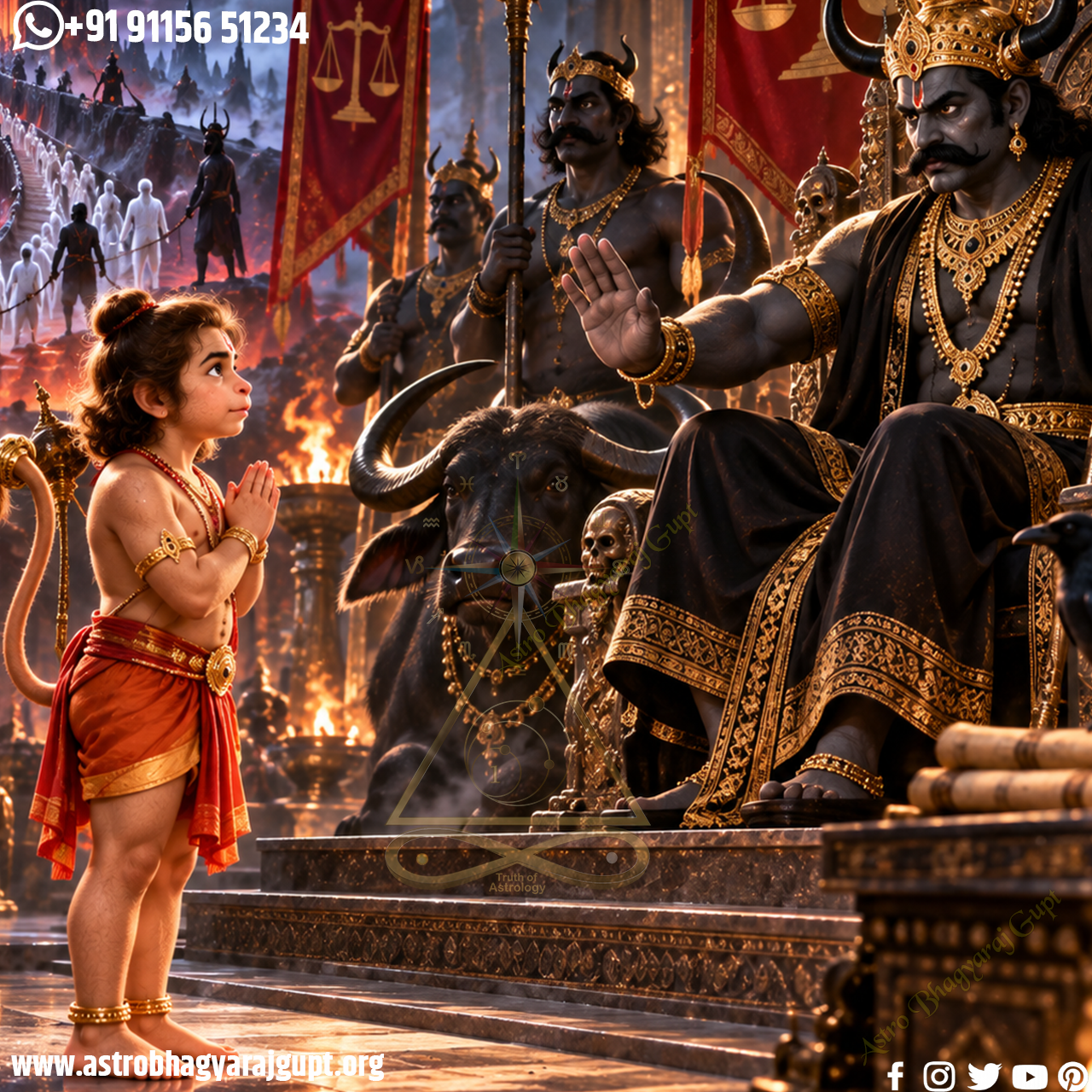
प्रेतलोक से होकर बाल हनुमान यमलोक पहुँच गए। विशाल यमसभा में चारों ओर गंभीर वातावरण था। सामने यमदेव अपने सिंहासन पर विराजमान थे।
यमदेव ने गंभीर स्वर में कहा,
“हनुमान, तुम्हारे पिता अब जीवित नहीं हो सकते। तुम यहाँ से चले जाओ।”
हनुमान ने विनम्र होकर कहा,
“यमदेव, मेरी प्रार्थना तो सुन लीजिए।”
यमदेव बोले,
“तुम्हारी प्रार्थना और निवेदन का यहाँ कोई अर्थ नहीं है। काल समस्त भावनाओं से ऊपर है। काल का सिंहासन और न्यायभूमि इसी लाल ध्वज की मर्यादा के कारण स्थिर है, क्योंकि काल स्वयं अपने नियमों का कठोरता से पालन करता है।”
हनुमान ने शांत स्वर में कहा,
“ठीक है, यमदेव। मैं यहाँ से चला जाऊँगा। न मैं आपसे युद्ध करूँगा और न ही कोई तर्क करूँगा। लेकिन मृत्यु के संबंध में मेरे मन में कुछ प्रश्न हैं। मैं केवल उनके उत्तर जानना चाहता हूँ।”
यमदेव ने पूछा,
“तुम होते कौन हो, जो मेरे पास प्रश्न करने आए हो?”
हनुमान ने उत्तर दिया,
“मैं वही पुत्र हूँ, जिसके पिता को आपने अन्यायपूर्वक असमय मृत्यु दी है। यमदेव, मैं केवल मृत्यु संबंधी कुछ प्रश्नों के उत्तर लेकर यहाँ से चला जाऊँगा।”
यमदेव बोले,
“हनुमान, मैं तुम्हारे प्रश्नों का उत्तर देने के लिए बाध्य नहीं हूँ।”
हनुमान मुस्कुराए और बोले,
“क्यों यमदेव? आप भयभीत हो रहे हैं? एक बालक के प्रश्नों का उत्तर देने से पीछे हट रहे हैं? क्या आप एक छोटी-सी चुनौती का सामना नहीं कर पा रहे?”
यमदेव का चेहरा गंभीर हो गया।
“काल से सभी भयभीत होते हैं। सभी काल को देखकर भयभीत होते हैं और स्वयं काल भी किसी से भयभीत नहीं होता। ठीक है, तुम प्रश्न करो। मैं तुम्हारे प्रश्नों का उत्तर दूँगा। लेकिन उत्तर प्राप्त होने के बाद तुम्हें यहाँ से चले जाना होगा।”
हनुमान ने कहा,
“मुझे उचित उत्तर मिलते ही मैं यहाँ से चला जाऊँगा।”
हनुमान ने पहला प्रश्न किया,
“कालदेव, मेरा पहला प्रश्न है—आत्मा क्या है?”
यमदेव बोले,
“आत्मा परमब्रह्म, परमात्मा का अंश है। जब तक वह देह में रहती है, तब तक अपने कर्मों के अनुसार सुख-दुःख का भोग करती है। देह से मुक्त होने के बाद वह कामना, लोभ, मोह आदि विकारों से ऊपर उठ जाती है। मोक्ष की स्थिति में वह पुनः परमात्मा में विलीन हो जाती है। आत्मा का कोई निश्चित रूप या आकार नहीं होता। वह सनातन और अविनाशी है। वही परमब्रह्म की वह ऊर्जा है, जिसके कारण जीवन संभव है।”
हनुमान ने दूसरा प्रश्न किया,
“मृत्यु के बाद आत्मा कहाँ चली जाती है, कालदेव?”
यमदेव ने उत्तर दिया,
“मृत्यु के बाद आत्मा का निवास उसके कर्मों के अनुसार निर्धारित होता है। सत्कर्म और सदाचार करने वाले मनुष्यों की आत्माएँ उच्च लोकों में निवास करती हैं। जिन आत्माओं को स्वर्ग की प्राप्ति होती है, वे शिवलोक, गोलोक, श्रीलोक, ब्रह्मलोक आदि लोकों में जाती हैं। यदि उनका पुनर्जन्म होता है, तो वे उच्च योनि अथवा श्रेष्ठ परिवार में जन्म लेती हैं।
कुछ आत्माएँ भूतलोक, प्रेतलोक और पिशाचलोक में भी भटकती हैं। जिन आत्माओं को किसी उच्च लोक की प्राप्ति नहीं होती, उन्हें उन्हीं लोकों में भटकना पड़ता है और उनका पुनर्जन्म भी निम्न योनि में हो सकता है।”
हनुमान ने तीसरा प्रश्न किया,
“एक आत्मा का दूसरी आत्मा से क्या संबंध होता है?”
यमदेव बोले,
“सभी आत्माएँ परमब्रह्म का अंश हैं, इसलिए सभी एक-दूसरे से जुड़ी हुई हैं। लेकिन उनके कर्मों के अनुसार उनके संबंध निर्धारित होते हैं। आत्मा-आत्मा के संबंध में कोई बड़ा या छोटा, दुर्बल या शक्तिशाली नहीं होता। पुण्यात्मा का संबंध पुण्यात्मा से और पापात्मा का संबंध पापात्मा से होता है। सभी आत्माओं का अंतिम लक्ष्य एक ही है—अपने-अपने कर्मों को पूर्ण करके अंततः परमात्मा में विलीन होना।”
हनुमान ने चौथा प्रश्न किया,
“किसी जीवधारी के जीवन और मृत्यु को कौन निर्धारित करता है?”
यमदेव ने कहा,
“किसी भी जीवधारी के जीवन और मृत्यु का निर्धारण स्वयं ब्रह्मदेव द्वारा किया जाता है।”
हनुमान ने पाँचवाँ प्रश्न किया,
“कब किसी जीव की मृत्यु होगी, इसका निर्धारण कैसे होता है?”
यमदेव बोले,
“उसकी श्वास की आहुति से।”
हनुमान ने तुरंत पूछा,
“उस श्वास की गणना कौन करता है?”
यमदेव ने उत्तर दिया,
“प्रत्येक जीवधारी की श्वास की गणना का अधिकार त्रिदेव ने शनिदेव को दिया है।”
यह सुनते ही हनुमान के मन में अपने पिता की मृत्यु से जुड़ा प्रश्न और भी गहरा हो गया।
उन्होंने कहा,
“तो कालदेव, मेरे पिता को मृत्यु देने के समय निश्चित ही आपने शनिदेव से पूछा होगा कि मेरे पिता की श्वास पूरी हुई थी या अभी कुछ श्वास बाकी थीं?”
यमदेव क्रोधित हो उठे।
“तुम इस प्रकार का प्रश्न मुझसे नहीं कर सकते!”
हनुमान ने दृढ़ स्वर में कहा,
“मेरे पिता की मृत्यु से जुड़ा यह प्रश्न है। उनके पुत्र को इसका उत्तर जानने का अधिकार है।”
कुछ क्षणों तक यमलोक में गहरा मौन छाया रहा।
फिर हनुमान ने सीधे पूछा,
“बताइए, कालदेव। मेरे पिता को मृत्यु देने के समय क्या आपने शनिदेव से जिज्ञासा की थी?”
यमदेव ने कठोर स्वर में उत्तर दिया,
“नहीं। मैंने उनसे कोई जिज्ञासा नहीं की। क्योंकि मुझे उनसे किसी भी बात के लिए पूछने की आवश्यकता नहीं है।”
उन्होंने आगे कहा,
“हनुमान, किसे अकाल मृत्यु देनी है या नहीं देनी है, इसका विशेष अधिकार मेरे अधीन है। शनिदेव हों या स्वयं त्रिदेव—मुझे किसी से कुछ पूछने या अनुमति लेने की आवश्यकता नहीं है।”
हनुमान ने तुरंत कहा,
“लेकिन अकाल मृत्यु भी तो बिना किसी आधार के नहीं दी जा सकती। उसका भी कोई कारण होना चाहिए।”
यमदेव बोले,
“पितृदोष के कारण भी अकाल मृत्यु हो सकती है। किसी प्राणी के दुष्कर्मों के परिणाम से भी अकाल मृत्यु का योग बन सकता है।”
हनुमान ने यमदेव की ओर देखते हुए शांत लेकिन गंभीर स्वर में अंतिम प्रश्न किया,
“तो फिर आप यह बताइए, कालदेव—क्या मेरे पिता के भाग्य में अकाल मृत्यु का योग पहले से ही बन चुका था?
हिमाचल प्रदेश के नंबर 1 ज्योतिषी एस्ट्रो भाग्यराज गुप्त द्वारा अपनी कुंडली का विश्लेषण करवाएं अपॉइंटमेंट के लिए इस लिंक पर क्लिक करें Appointment With Aacharya Ji by Call | आचार्य जी से फ़ोन पर बात करें पर या मोबाइल नंबर +91 91156 51234 पर संपर्क कर सकते हैं। ॐ नमो भगवते वासुदेवाय नमः
English:
🌺 Yamadeva Falls Silent at Hanuman’s Question — The Mystery of Kesari’s Death Begins to Unfold 🌺
Passing through the realm of spirits, the young Hanuman arrived at Yamaloka. A solemn atmosphere pervaded the vast court of Yama. Before him, Yamadeva sat upon his throne.
Yamadeva spoke in a grave voice:
“Hanuman, your father cannot be brought back to life. You must leave this place.”
Hanuman replied humbly:
“Yamadeva, please hear my plea.”
Yamadeva said:
“Your prayers and pleas hold no meaning here. *Kaal* (Time/Death) transcends all emotions. The throne of *Kaal* and the seat of justice remain steadfast because of the sanctity of this red banner; for *Kaal* itself strictly adheres to its own laws.”
Hanuman said in a calm voice:
“Very well, Yamadeva. I shall leave. I will neither wage war against you nor engage in argument. However, I harbor certain questions regarding death. I merely wish to know the answers.”
Yamadeva asked:
“Who are you to come here questioning me?”
Hanuman replied:
“I am the son whose father you have unjustly subjected to an untimely death. Yamadeva, I shall depart once I have the answers to a few questions concerning death.”
Yamadeva said:
“Hanuman, I am under no obligation to answer your questions.”
Hanuman smiled and said:
“Why, Yamadeva? Are you afraid? Are you shying away from answering a child’s questions? Can you not face a simple challenge?”
Yamadeva’s expression turned stern.
“All beings fear *Kaal*. Everyone trembles at the sight of *Kaal*, yet *Kaal* itself fears no one. Very well, ask your questions. I shall answer them. But once you have the answers, you must leave this place.”
Hanuman said
“I shall leave as soon as I receive satisfactory answers.” Hanuman asked the first question,
“Kaaldev, my first question is—what is the soul?”
Yamdev replied,
“The soul is a fragment of the Supreme Being—the *Parambrahma* or *Paramatma*. As long as it resides within the body, it experiences happiness and sorrow according to its deeds. Upon being liberated from the body, it rises above afflictions such as desire, greed, and attachment. In the state of *Moksha* (liberation), it merges back into the Supreme Being. The soul has no fixed form or shape; it is eternal and imperishable. It is that very energy of the Supreme Being which makes life possible.”
Hanuman asked the second question,
“Where does the soul go after death, Kaaldev?”
Yamdev answered,
“After death, the soul's abode is determined by its deeds. The souls of those who have performed virtuous acts and led righteous lives reside in higher realms. Souls that attain heaven proceed to realms such as *Shivaloka*, *Goloka*, *Shriloka*, and *Brahmaloka*. Should they be reborn, they are born into a noble species or an exalted family.
However, the souls of those who have committed evil deeds and led unrighteous lives go to lower realms. In *Yamloka*, they must endure punishment for their misdeeds. Some souls wander in the realms of *Bhutas* (spirits), *Pretas* (restless ghosts), and *Pishachas* (demonic entities). Souls that do not attain a higher realm are compelled to wander within these lower planes, and their rebirth may occur in a lowly life form.”
Hanuman asked the third question,
“What is the relationship between one soul and another?” Yama said,
“All souls are fragments of the Supreme Brahman; therefore, they are all interconnected. However, their relationships are determined by their deeds. In the bond between souls, there is no distinction of high or low, weak or powerful. A virtuous soul connects with a virtuous soul, and a sinful soul with a sinful soul. All souls share the same ultimate goal—to fulfill their respective karmas and eventually merge into the Supreme Soul.”
Hanuman asked his fourth question,
“Who determines the life and death of a living being?”
Yama replied,
“The life and death of any living being are determined by Lord Brahma himself.”
Hanuman asked his fifth question,
“How is the moment of a living being's death determined?”
Yama said,
“By the tally of their breaths.”
Hanuman immediately asked,
“Who keeps count of those breaths?”
Yama answered,
“The Trinity has entrusted the task of counting every living being's breaths to Shani Dev.”
Upon hearing this, the question regarding his father's death weighed even more heavily on Hanuman's mind.
He said,
“Then, O Lord of Time, at the moment of my father's death, you must surely have asked Shani Dev whether his allotted breaths were exhausted or if some still remained?”
Yama grew angry.
“You cannot ask me such a question!”
Hanuman said in a firm voice,
“This question concerns my father's death. His son has the right to know the answer.”
A profound silence descended upon Yamaloka for a few moments.
Then, Hanuman asked directly,
“Tell me, O Lord of Time. Did you consult Shani Dev at the time of my father's death?”
Yama replied in a stern voice,
“No. I did not consult him. For I have no need to ask him about anything.” He further said,
“Hanuman, the exclusive authority to decide whether or not to inflict untimely death rests with me. Be it Shani Dev or the Trinity themselves—I need not consult or seek permission from anyone.”
Hanuman immediately replied,
“But untimely death cannot be decreed without grounds, either. There must be a reason for it.”
Yamdev said,
“Untimely death can occur due to *Pitra Dosh* (ancestral affliction). It can also be brought about by the consequences of a being's misdeeds.”
Hanuman...🌺 Yamadeva Falls Silent at Hanuman’s Question — The Mystery of Kesari’s Death Begins to Unfold 🌺
Passing through the realm of spirits, the young Hanuman arrived at Yamaloka. A solemn atmosphere pervaded the vast court of Yama. Before him, Yamadeva sat upon his throne.
Yamadeva spoke in a grave voice:
“Hanuman, your father cannot be brought back to life. You must leave this place.”
Hanuman replied humbly:
“Yamadeva, please hear my plea.”
Yamadeva said:
“Your prayers and pleas hold no meaning here. *Kaal* (Time/Death) transcends all emotions. The throne of *Kaal* and the seat of justice remain steadfast because of the sanctity of this red banner; for *Kaal* itself strictly adheres to its own laws.”
Hanuman said in a calm voice:
“Very well, Yamadeva. I shall leave. I will neither wage war against you nor engage in argument. However, I harbor certain questions regarding death. I merely wish to know the answers.”
Yamadeva asked:
“Who are you to come here questioning me?”
Hanuman replied:
“I am the son whose father you have unjustly subjected to an untimely death. Yamadeva, I shall depart once I have the answers to a few questions concerning death.”
Yamadeva said:
“Hanuman, I am under no obligation to answer your questions.
Hanuman smiled and said:
“Why, Yamadeva? Are you afraid? Are you shying away from answering a child’s questions? Can you not face a simple challenge?”
Yamadeva’s expression turned stern.
“All beings fear *Kaal*. Everyone trembles at the sight of *Kaal*, yet *Kaal* itself fears no one. Very well, ask your questions. I shall answer them. But once you have the answers, you must leave this place.”
Hanuman said:
“I shall leave as soon as I receive satisfactory answers.” Hanuman asked the first question,
“Kaaldev, my first question is—what is the soul?”
Yamdev replied,
“The soul is a fragment of the Supreme Being—the *Parambrahma* or *Paramatma*. As long as it resides within the body, it experiences happiness and sorrow according to its deeds. Upon being liberated from the body, it rises above afflictions such as desire, greed, and attachment. In the state of *Moksha* (liberation), it merges back into the Supreme Being. The soul has no fixed form or shape; it is eternal and imperishable. It is that very energy of the Supreme Being which makes life possible.”
Hanuman asked the second question,
“Where does the soul go after death, Kaaldev?”
Yamdev answered,
“After death, the soul's abode is determined by its deeds. The souls of those who have performed virtuous acts and led righteous lives reside in higher realms. Souls that attain heaven proceed to realms such as *Shivaloka*, *Goloka*, *Shriloka*, and *Brahmaloka*. Should they be reborn, they are born into a noble species or an exalted family.
However, the souls of those who have committed evil deeds and led unrighteous lives go to lower realms. In *Yamloka*, they must endure punishment for their misdeeds. Some souls wander in the realms of *Bhutas* (spirits), *Pretas* (restless ghosts), and *Pishachas* (demonic entities). Souls that do not attain a higher realm are compelled to wander within these lower planes, and their rebirth may occur in a lowly life form.”
Hanuman asked the third question,
“What is the relationship between one soul and another?” Yama said,
“All souls are fragments of the Supreme Brahman; therefore, they are all interconnected. However, their relationships are determined by their deeds. In the bond between souls, there is no distinction of high or low, weak or powerful. A virtuous soul connects with a virtuous soul, and a sinful soul with a sinful soul. All souls share the same ultimate goal—to fulfill their respective karmas and eventually merge into the Supreme Soul.”
Hanuman asked his fourth question,
“Who determines the life and death of a living being?”
Yama replied,
“The life and death of any living being are determined by Lord Brahma himself.”
Hanuman asked his fifth question,
“How is the moment of a living being's death determined?”
Yama said,
“By the tally of their breaths.”
Hanuman immediately asked,
“Who keeps count of those breaths?”
Yama answered,
“The Trinity has entrusted the task of counting every living being's breaths to Shani Dev.”
Upon hearing this, the question regarding his father's death weighed even more heavily on Hanuman's mind.
He said,
“Then, O Lord of Time, at the moment of my father's death, you must surely have asked Shani Dev whether his allotted breaths were exhausted or if some still remained?”
Yama grew angry.
“You cannot ask me such a question!”
Hanuman said in a firm voice,
“This question concerns my father's death. His son has the right to know the answer.”
A profound silence descended upon Yamaloka for a few moments.
Then, Hanuman asked directly,
“Tell me, O Lord of Time. Did you consult Shani Dev at the time of my father's death?”
Yama replied in a stern voice,
“No. I did not consult him. For I have no need to ask him about anything.” He further said,
“Hanuman, the exclusive authority to decide whether or not to inflict untimely death rests with me. Be it Shani Dev or the Trinity themselves—I need not consult or seek permission from anyone.”
Hanuman immediately replied,
“But untimely death cannot be decreed without grounds, either. There must be a reason for it.”
Yamdev said,
“Untimely death can occur due to *Pitra Dosh* (ancestral affliction). It can also be brought about by the consequences of a being's misdeeds.”
Hanuman...
बाल हनुमान, बाल हनुमान की कहानी, बाल हनुमान कथा, बाल हनुमान और यमदेव, हनुमान यमलोक, हनुमान जी यमलोक क्यों गए, हनुमान यमलोक की कथा, हनुमान और यमराज, हनुमान जी और यमराज की कथा, यमदेव से हनुमान का प्रश्न, हनुमान ने यमदेव से क्या पूछा, यमदेव का रहस्य, यमलोक का रहस्य, यमलोक की कहानी, यमलोक की पौराणिक कथा, केसरी की मृत्यु, केसरी की मृत्यु का रहस्य, केसरी की मृत्यु कैसे हुई, केसरी की मृत्यु क्यों हुई, केसरी और हनुमान, केसरी पुत्र हनुमान, केसरी महाराज, केसरी की कहानी, हनुमान के पिता केसरी, हनुमान जी के पिता, केसरी के पिता हनुमान, हनुमान जी की कथा, हनुमान जी की पौराणिक कथा, हनुमान जी की कहानी, भगवान हनुमान की कथा, हनुमान कथा हिंदी, हनुमान जी का रहस्य, हनुमान जी की शक्ति, बाल हनुमान की शक्ति, हनुमान जी का बचपन, हनुमान जी के बाल रूप की कथा, अकाल मृत्यु, अकाल मृत्यु का रहस्य, अकाल मृत्यु क्यों होती है, अकाल मृत्यु का कारण, मृत्यु का रहस्य, मृत्यु का सच, मृत्यु के बाद क्या होता है, मृत्यु के बाद आत्मा कहाँ जाती है, आत्मा कहाँ जाती है, आत्मा का रहस्य, आत्मा क्या है, आत्मा और परमात्मा, आत्मा और कर्म, कर्म और मृत्यु, कर्मों का फल, कर्म का रहस्य, जन्म और मृत्यु का रहस्य, जन्म मृत्यु का चक्र, पुनर्जन्म का रहस्य, पुनर्जन्म और कर्म, यमराज का न्याय, यमदेव का न्याय, यमराज की कथा, यमराज और आत्मा, यमलोक में आत्मा, यमलोक में क्या होता है, मृत्यु के बाद यमलोक, यमलोक का सच, स्वर्ग और नरक, स्वर्ग लोक, नरक लोक, प्रेतलोक, भूतलोक, पिशाचलोक, आत्मा के लोक, सनातन धर्म कथा, हिंदू पौराणिक कथा, धार्मिक कहानी, धार्मिक कथा हिंदी, पौराणिक कहानी हिंदी, पौराणिक कथा हिंदी, आध्यात्मिक कहानी, आध्यात्मिक ज्ञान, सनातन धर्म ज्ञान, हिंदू धर्म ज्ञान, धर्म और कर्म, कर्म और भाग्य, भाग्य और मृत्यु, मृत्यु और भाग्य, जीवन और मृत्यु, जीवन मृत्यु का रहस्य, श्वास और मृत्यु, सांसों की गणना, मृत्यु का समय, मृत्यु कब आती है, मृत्यु का निर्धारण, यमदेव और शनि देव, शनिदेव और मृत्यु, शनिदेव की भूमिका, ब्रह्मदेव और मृत्यु, त्रिदेव और मृत्यु, कालदेव, काल का रहस्य, काल और मृत्यु, कालदेव यमराज, यमराज का रहस्य, हनुमान जी का सवाल, हनुमान का सवाल यमराज से, हनुमान ने पूछा सवाल, यमराज हुए मौन, यमदेव हुए मौन, हनुमान की चुनौती, हनुमान और कालदेव, केसरी की अकाल मृत्यु, क्या केसरी की मृत्यु अकाल थी, केसरी की मृत्यु का सच, केसरी की मृत्यु का कारण, हनुमान के पिता की मृत्यु, हनुमान के पिता की कहानी, पिता की मृत्यु का रहस्य, हनुमान जी का अपने पिता से संबंध, हनुमान जी की अद्भुत कथा, हनुमान जी की अनसुनी कहानी, हनुमान जी की रहस्यमयी कथा, हनुमान जी की चमत्कारी कथा, भगवान हनुमान की कहानी, महाबली हनुमान, पवनपुत्र हनुमान, अंजनी पुत्र हनुमान, केसरीनंदन हनुमान, बजरंगबली, हनुमान भक्ति, हनुमान कथा, हनुमान कहानी, हनुमान जी के रहस्य, धार्मिक रहस्य, पौराणिक रहस्य, सनातन धर्म रहस्य, हिंदू धर्म के रहस्य, मृत्यु से जुड़े रहस्य, आत्मा से जुड़े रहस्य, यमलोक रहस्य, यमराज रहस्य, कर्मों का हिसाब, यमराज का दरबार, यमसभा, यमराज का सिंहासन, हनुमान यमसभा, हनुमान यमराज दरबार, बाल हनुमान यमराज दरबार, केसरी और यमराज, केसरी हनुमान कथा, हनुमान जी की अनोखी कथा, हनुमान जी का ज्ञान, हनुमान जी का साहस, हनुमान जी की बुद्धि, हनुमान जी का प्रश्न, यमदेव से सवाल, यमराज से सवाल, मृत्यु पर हनुमान का प्रश्न, आत्मा पर हनुमान का प्रश्न, कर्म पर हनुमान का प्रश्न, सनातन कथा, धार्मिक ज्ञान, आध्यात्मिक ज्ञान हिंदी, हिंदू कथा, देवी देवताओं की कथा, भगवानों की कथा, पौराणिक ज्ञान, धर्म ज्ञान, भक्ति कथा, भक्ति कहानी, हनुमान भक्ति कथा, हनुमान जी की भक्ति, राम भक्त हनुमान, संकटमोचन हनुमान, वीर हनुमान, महावीर हनुमान, बजरंगबली की कथा, हनुमान जी का इतिहास, हनुमान जी के बारे में, हनुमान जी की लीलाएं, हनुमान जी की लीला, हनुमान जन्म कथा, हनुमान बाल लीला, हनुमान जी के चमत्कार, हनुमान जी की शक्ति का रहस्य, मृत्यु और मोक्ष, आत्मा और मोक्ष, मोक्ष का रहस्य, परमात्मा और आत्मा, ब्रह्म और आत्मा, सनातन सत्य, जीवन का सत्य, मृत्यु का सत्य, कर्म का सत्य, भाग्य का सत्य, यमलोक यात्रा, प्रेतलोक यात्रा, हनुमान की यमलोक यात्रा, बाल हनुमान की यमलोक यात्रा, यमलोक जाने की कथा, हनुमान यमलोक क्यों पहुंचे, हनुमान यमराज के पास क्यों गए, केसरी के लिए हनुमान, पिता के लिए हनुमान, हनुमान का न्याय, यमदेव का निर्णय, केसरी की मृत्यु का निर्णय, अकाल मृत्यु का योग, मृत्यु का योग, कुंडली और मृत्यु, ज्योतिष और मृत्यु, मृत्यु योग ज्योतिष, पितृदोष और अकाल मृत्यु, पितृदोष का रहस्य, दुष्कर्म और मृत्यु, कर्मफल और मृत्यु, अच्छे कर्म और मृत्यु, बुरे कर्म और मृत्यु, पुनर्जन्म का सच, आत्मा का सफर, मृत्यु के बाद आत्मा का सफर, आत्मा की यात्रा, यमलोक में न्याय, कर्मों का न्याय, यमराज का दरबार कथा, यमदेव की कथा, कालदेव की कथा, काल का न्याय, मृत्यु का न्याय, हनुमान जी का न्याय, केसरी मृत्यु कथा, केसरी मृत्यु रहस्य हिंदी, हनुमान कथा वायरल, धार्मिक कथा वायरल, पौराणिक कथा वायरल, सनातन धर्म वायरल कथा, हनुमान जी वायरल कहानी, हनुमान यमराज वायरल कथा, यमराज हनुमान कहानी, केसरी हनुमान रहस्य, बाल हनुमान रहस्य, हनुमान जी के अनसुने रहस्य, सनातन धर्म की कथा, हिंदू धर्म की पौराणिक कथा, धार्मिक रहस्यमयी कहानी, आध्यात्मिक रहस्य कथा, मृत्यु की अनसुनी कहानी, यमलोक की अनसुनी कथा, हनुमान जी की अनसुनी कथा, केसरी की अनसुनी कहानी, हनुमान और मृत्यु, हनुमान और काल, हनुमान जी काल से संवाद, यमराज से संवाद, हनुमान यमदेव संवाद, यमदेव हनुमान संवाद, आत्मा और मृत्यु संवाद, मृत्यु और कर्म की कहानी, जीवन मृत्यु और कर्म, कर्मफल का सिद्धांत, सनातन धर्म में मृत्यु, हिंदू धर्म में मृत्यु, मृत्यु के बाद जीवन, आत्मा अमर है, आत्मा अविनाशी है, परमात्मा का अंश आत्मा, कर्मों के अनुसार पुनर्जन्म, मृत्यु के बाद लोक, स्वर्ग नरक का रहस्य, यमलोक और स्वर्ग, प्रेतलोक और आत्मा, मोक्ष और पुनर्जन्म, जन्म मृत्यु मोक्ष, सनातन धर्म का ज्ञान, हिंदू आध्यात्मिक ज्ञान, धार्मिक शिक्षा, पौराणिक ज्ञान हिंदी, हनुमान जी की शिक्षाप्रद कथा, हनुमान जी से सीख, हनुमान कथा से ज्ञान, हनुमान जी का अद्भुत साहस, बाल हनुमान का साहस, बाल हनुमान की बुद्धिमत्ता, यमराज के सामने हनुमान, यमदेव के सामने हनुमान, हनुमान का निर्भय रूप, हनुमान जी का निर्भय स्वरूप, हनुमान जी की वीरता, बजरंगबली की वीरता, हनुमान जी का पराक्रम, केसरी के पुत्र का प्रश्न, हनुमान का पिता के लिए संघर्ष, केसरी की मृत्यु पर हनुमान, पिता की मृत्यु पर हनुमान, हनुमान का सवाल, यमराज का जवाब, यमदेव का जवाब, मृत्यु के प्रश्न, आत्मा के प्रश्न, कर्म के प्रश्न, अकाल मृत्यु के प्रश्न, मृत्यु का रहस्य हिंदी, आत्मा का रहस्य हिंदी, यमलोक का रहस्य हिंदी, केसरी की मृत्यु हिंदी, हनुमान यमलोक हिंदी, हनुमान यमराज हिंदी, बाल हनुमान हिंदी कथा, धार्मिक वीडियो keywords, spiritual story hindi, lord hanuman story, bal hanuman story, hanuman and yamraj, hanuman yama story, kesari death mystery, hanuman father kesari, death mystery hindu mythology, hindu mythology story, sanatan dharma story, hindu spiritual story, soul after death, mystery of death, karma and death, rebirth hinduism, yamraj story, yama loka story, hanuman mythology, lord hanuman mythology, ancient hindu stories, hindu religious stories, devotional story hindi, horoscope reading, jyotish astrology, chat with astrologer, birth chart astrology, best astrology site, astrology books, near me astrologer, my astrology chart, best astrologer in india for consultation, best astrology app in india, astrology chart reading, accurate astrology predictions free, free horoscope reading, vedic astrology predictions, predict my future free, astrology services, best astrologer in the world, my future prediction, good astrologer in bangalore, zodiac chart, astrologer talk free, best jyotish near me, good astrologer, online astrology prediction, love life prediction by date of birth free, astrologer in pune, top 10 astrologer in india, best astrologer in gurgaon, future horoscope by date of birth, free birth chart calculator, time of birth, top astrologer in bangalore, best jyotish in india, famous astrologers, best astrologer in delhi with fees, astrologer in gurgaon, astrology future prediction, famous astrologer near me, famous astrologer near me, best astrology website, face reader astrologer, professional astrologer, astrologer in mumbai, my moon sign, most accurate life prediction free, best astrology books, best astrology app free, astrology based on date of birth, online janam kundali, janam kundali by date of birth, kundali app, kundli app, financial astrology, janam kundali free, indian astrology predictions, online horoscope generator, numerology horoscope, zodiac sign chart, horoscope check, best love astrologer, free online astrology course with certificate, the best astrology app, pandit astrologer near me, pandit astrologer, astrology services near me, best love astrologer, marriage astrology by date of birth, online jyotish free, kundli kaise dekhe, janam patri, marriage prediction astrology, best kundli matching, janmakshar online, janamakshar, online kundali marathi, daily astrology, free numerology report, astrologer in noida, career horoscope, kundali kaise dekhe, online kundli analysis, free marriage prediction by date of birth, check horoscope online, kundli, janam kundli online free, free janam kundali in hindi, vastu, astrology classes online, good astrologer in mumbai, good astrologer in india, lal kitab kundli, top 10 astrologer in delhi, famous astrologer in delhi, zodiac chart generator, online marriage matching, find my zodiac sign, birth time rectification, best birth chart, biggest astrologer in india, top ten astrologer in india, best indian astrologer in india, birth chart astro, marriage calculator by date of birth, josiyar near me, marriage date prediction, astrology chart analysis, numerology birth chart, birth chart free online, janam kundali marathi, my astrology today, house chart astrology, astrology kundali, horoscope moon sign, free kundli, jyotish app, how to know rashi, best numerologist, janam patrika, vedic birth chart calculator, free chat with astrologer on whatsapp, yearly horoscope, free marriage prediction by name and date of birth, online janam kundli, check horoscope by date of birth, astrology report, find rashi by date of birth, ai astrology predictions, free career prediction by date of birth, best astrology chart, janma patrika, free kundali reading, marriage matching calculator, good astrologer in pune, horoscope matching by date of birth, kundli report, natal chart readings, janam patrika online, best jyotish in mumbai, gemstone by date of birth, kundali report, best astrologer Ahmedabad,
100% SECURE PAYMENT
Your transactions are protected with industry-leading encryption and security protocols. We ensure complete safety of your personal and payment information. Trust us with your confidential data as we use certified payment gateways and SSL technology.


