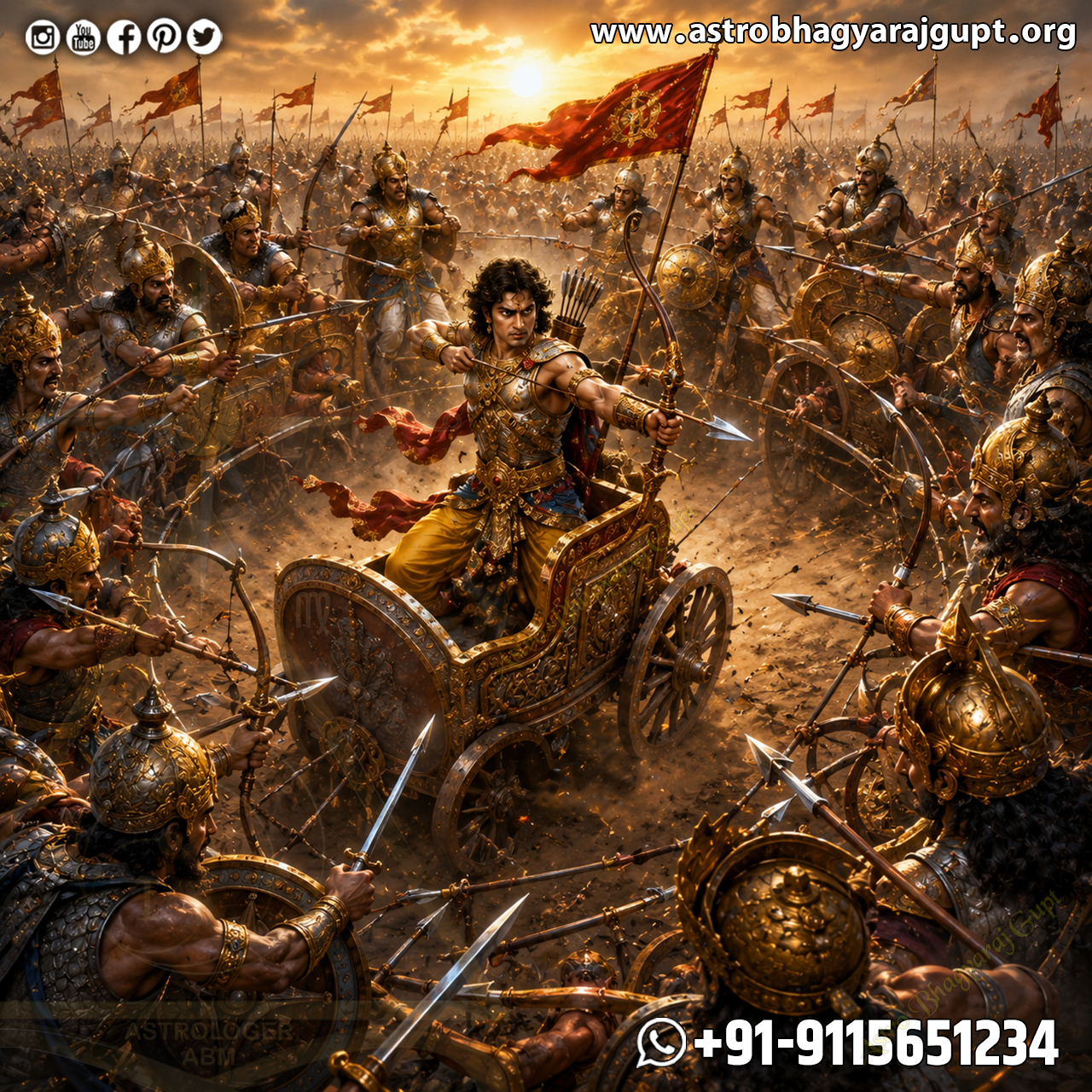
महाभारत का रहस्य:अभिमन्यु की अमर गाथा | The Mystery of the Mahabharata: The Immortal Saga of Abhimanyu
Hindi:
महाभारत युद्ध में अभिमन्यु के लिए कौरवों ने सात चक्रव्यूह की रचना आखिर क्यों की थी? कारण जानकर आप रह जाएंगे हैरान
महाभारत का युद्ध केवल अस्त्र-शस्त्र का युद्ध नहीं था। यह रणनीति, कूटनीति, धर्म, अधर्म, प्रतिज्ञा और प्रतिशोध का महासंग्राम था। कुरुक्षेत्र के 18 दिनों में जो घटनाएँ घटीं, उनमें 13वें दिन का युद्ध सबसे मार्मिक, सबसे विवादित और सबसे निर्णायक मोड़ था। उस दिन एक 16 वर्ष का बालक अकेले ही कौरवों की सम्पूर्ण सेना पर भारी पड़ गया। उसका नाम था — अभिमन्यु।
उस दिन द्रोणाचार्य ने चक्रव्यूह की रचना की। पर प्रश्न यह है — चक्रव्यूह तो युद्ध की एक सामान्य व्यूह-रचना थी। फिर अभिमन्यु के लिए ही सात चक्रों वाला विशेष चक्रव्यूह क्यों? पूरी कौरव सेना, महारथी, अतिरथी — सब मिलकर एक बालक को घेरने क्यों लगे?
इसका उत्तर जानने के लिए हमें युद्ध के 12 दिनों का मनोविज्ञान, अभिमन्यु का जन्म रहस्य, दुर्योधन का भय, और जयद्रथ के वरदान तक जाना होगा।
1. चक्रव्यूह क्या है: पहले इसे समझें
युद्ध में सेना को अलग-अलग आकार में खड़ा करना “व्यूह” कहलाता है। गरुड़व्यूह, मकरव्यूह, क्रौंचव्यूह, मंडलव्यूह, शकटव्यूह — ये सब नाम आपने सुने होंगे।
चक्रव्यूह/पद्मव्यूह सबसे जटिल व्यूहों में से एक था। यह दिखने में कमल के फूल जैसा था। इसमें सेना गोल-गोल घूमते हुए 7 से 9 परतों में खड़ी होती थी। हर परत में महारथी योद्धा होते थे।
इसकी 3 खास बातें:
प्रवेश आसान, निकास असंभव: इसमें घुसना वीरता से संभव है, पर निकलने का तरीका अलग होता है। जो योद्धा अंदर जाता है, घूमते हुए चक्र उसे अंदर खींचते जाते हैं। हर परत तोड़ने के बाद अगली परत और कठिन।
मनोवैज्ञानिक दबाव: अंदर फँसे योद्धा को लगता है कि दुश्मन चारों ओर है। दिशा भ्रम हो जाता है।
समय का खेल: चक्रव्यूह तोड़ने में समय लगता है। तब तक बाकी सेना मुख्य युद्ध से कट जाती है।
आचार्य द्रोण चक्रव्यूह के सबसे बड़े ज्ञाता थे। अर्जुन भी इसे तोड़ना जानता था। पर समस्या यह थी — 13वें दिन अर्जुन युद्ध भूमि में नहीं था।
2. 13वें दिन की सुबह: वह चाल जो सब पर भारी पड़ी
12 दिन युद्ध हो चुका था। भीष्म शरशय्या पर थे। द्रोण अब कौरव सेनापति थे। दुर्योधन रोज़ उन पर दबाव डालता — “युधिष्ठिर को बंदी बना लो, युद्ध खत्म।”
द्रोणाचार्य ने वचन दिया — “कल मैं चक्रव्यूह रचूँगा। अगर अर्जुन युद्ध में नहीं हुआ, तो मैं युधिष्ठिर को पकड़ लूँगा।”
यहाँ कौरवों ने पहली चाल चली। त्रिगर्त देश के राजा सुशर्मा को बुलाया। सुशर्मा और अर्जुन की पुरानी दुश्मनी थी। उसने प्रतिज्ञा की — “मैं अर्जुन को युद्ध के लिए ललकारूँगा और दक्षिण दिशा में दूर ले जाऊँगा।” इसे “संशप्तक यज्ञ” कहा गया। हजारों सैनिकों ने प्राण की बाजी लगाकर अर्जुन को उलझा दिया।
नतीजा: 13वें दिन अर्जुन मुख्य युद्ध से मीलों दूर था। पांडव सेना सेनापति विहीन हो गई। यही मौका था द्रोण के लिए चक्रव्यूह रचने का।
3. अभिमन्यु ही क्यों? 16 साल का बालक क्यों चुना गया?
पांडव खेमे में हड़कंप मच गया। चक्रव्यूह तोड़ना सिर्फ 4 लोग जानते थे — कृष्ण, अर्जुन, प्रद्युम्न और अभिमन्यु। कृष्ण-अर्जुन युद्ध में नहीं। प्रद्युम्न द्वारका में। बचा कौन? अभिमन्यु।
अभिमन्यु का रहस्य:
अभिमन्यु कोई साधारण बालक नहीं था। वह अर्जुन और सुभद्रा का पुत्र, श्रीकृष्ण का भांजा था। कहते हैं वह पिछले जन्म में “वर्चा” नामक देवता था, जो चंद्रमा का पुत्र था। शर्त थी कि वह 16 साल के लिए ही पृथ्वी पर आएगा।
गर्भ में शिक्षा: कथा प्रसिद्ध है कि जब अभिमन्यु सुभद्रा के गर्भ में था, अर्जुन सुभद्रा को चक्रव्यूह तोड़ने की कथा सुना रहे थे। सुभद्रा बीच में सो गईं। अभिमन्यु ने गर्भ में ही 6 चक्र तोड़ने तक की विद्या सुन ली। 7वें चक्र की विद्या वह नहीं सुन पाया। यही उसकी मृत्यु का कारण बनी।
युधिष्ठिर ने पूछा — “हे वत्स, क्या तुम चक्रव्यूह तोड़ सकते हो?”
अभिमन्यु बोला — “प्रवेश करना जानता हूँ महाराज, पर निकलना नहीं। पर आप मेरे पीछे-पीछे आइए। मैं रास्ता बनाऊँगा, आप मेरी रक्षा करना।”
पांडवों ने स्वीकार कर लिया। एक 16 साल के बालक के कंधों पर पूरा धर्मयुद्ध आ गया।
4. सात चक्रों वाला चक्रव्यूह: सामान्य नहीं था यह व्यूह
आमतौर पर चक्रव्यूह 6 या 7 परतों का होता था। पर 13वें दिन द्रोण ने “सप्त-चक्रव्यूह” रचा — 7 परत, और हर परत में महारथी। यह अभिमन्यु के लिए स्पेशल डिज़ाइन था।
क्यों 7 चक्र? 5 कारण:
कारण 1: अभिमन्यु की गति रोकना
अभिमन्यु का रथ वायु वेग से चलता था। उसके घोड़े श्रीकृष्ण के घोड़ों की नस्ल के थे। वह अकेला ही सेना को चीर देता था। 1-2 परत वाला व्यूह उसे रोक नहीं पाता। इसलिए 7 परतों में उसे “थकाने” की रणनीति थी। हर चक्र पर उसे ऊर्जा खर्च करनी पड़ती।
कारण 2: अर्जुन का भय
दुर्योधन जानता था — अगर अभिमन्यु मर गया, तो अर्जुन पागल हो जाएगा। शोक में या क्रोध में वह कोई गलती कर बैठेगा। कौरव यही चाहते थे। अभिमन्यु को “चारा” बनाकर अर्जुन को मानसिक रूप से तोड़ना था। इसलिए उसे ऐसा व्यूह में फँसाना था जहाँ से जिंदा निकलना नामुमकिन हो।
कारण 3: जयद्रथ का वरदान
यह सबसे बड़ा कारण था। जयद्रथ, दुर्योधन की बहन दुश्शला का पति था। वनवास के समय उसने द्रौपदी का हरण करने की कोशिश की थी। भीम ने उसे मारा नहीं, पर सिर मूँडकर अपमानित किया।
जयद्रथ ने शिव की तपस्या की — “मुझे पांडवों को हराने का वरदान दो।” शिव ने कहा — “तू 1 दिन के लिए अर्जुन को छोड़कर 4 पांडवों को रोक सकेगा।”
13वें दिन जयद्रथ इसी वरदान के साथ खड़ा था। प्लान यह था — अभिमन्यु अंदर जाएगा। पीछे से युधिष्ठिर, भीम, नकुल, सहदेव आएँगे। पर जयद्रथ उन्हें “गेट” पर ही रोक देगा। अभिमन्यु अकेला पड़ जाएगा। 7 चक्र इसलिए थे ताकि अभिमन्यु को सबसे अंदर, सबसे दूर ले जाया जाए।
कारण 4: सामूहिक पाप का डर
कौरव जानते थे — अभिमन्यु अर्जुन का बेटा है। उस पर अकेले वार करना मतलब अर्जुन से दुश्मनी। कोई महारथी अकेले उसका सामना नहीं करना चाहता था। कर्ण को परशुराम का श्राप था कि “जब तुझे सबसे ज्यादा जरूरत होगी, तू विद्या भूल जाएगा।” द्रोण गुरु थे, शिष्य-पुत्र पर वार नहीं कर सकते थे।
इसलिए “सामूहिक” हमला प्लान किया। 7 चक्रों में 7 महारथी — द्रोण, कर्ण, कृपाचार्य, अश्वत्थामा, दुर्योधन, दुःशासन, शल्य। सब मिलकर वार करें तो पाप बँट जाएगा। अर्जुन किस-किस से बदला लेगा? यही कायर रणनीति थी।
कारण 5: युधिष्ठिर को जिंदा पकड़ना
द्रोण का मुख्य लक्ष्य युधिष्ठिर था। पर अभिमन्यु के घुसते ही पांडव सेना उसके पीछे भागी। द्रोण को डर था कि कहीं युधिष्ठिर भी अंदर न घुस जाए और मारा जाए। मरा हुआ युधिष्ठिर दुर्योधन के किसी काम का नहीं था। उसे जिंदा बंदी चाहिए था।
इसलिए 7 चक्रों वाला गहरा व्यूह बनाया — ताकि अभिमन्यु सबसे अंदर जाकर फँस जाए, और युधिष्ठिर को जयद्रथ पहले ही रोक दे। युद्ध दो हिस्सों में बँट गया।
5. अंदर क्या हुआ: एक बालक vs 7 महारथी
अभिमन्यु चक्रव्यूह में घुसा। उसने पहले ही चक्र में धावा बोल दिया। उसके बाणों से कौरव सेना में हाहाकार मच गया।
पहला चक्र: दुर्योधन का बेटा लक्ष्मण सामने आया। अभिमन्यु ने एक ही बाण में उसका वध कर दिया।
दूसरा चक्र: शल्य से युद्ध। शल्य को मूर्छित कर दिया।
तीसरा चक्र: बृहद्बल, कोसल का राजा। उसका वध।
चौथा चक्र: दुर्योधन खुद आया। अभिमन्यु ने उसे 10 बाण मारकर रथहीन कर दिया।
पाँचवाँ चक्र: दुःशासन का बेटा। मारा गया।
छठा चक्र: कर्ण से युद्ध। कर्ण के धनुष की डोर काट दी, रथ तोड़ दिया।
अभिमन्यु 6 चक्र तोड़ चुका था। अब 7वाँ और अंतिम चक्र। यहीं वह रुक गया। निकलने की विद्या उसे नहीं आती थी। पीछे मुड़ा तो देखा — कोई नहीं। जयद्रथ ने भीम, युधिष्ठिर सबको रोक दिया था।
अब शुरू हुआ अधर्म:
नियम था — “रथी से रथी लड़े, निहत्थे पर वार न हो, एक पर एक ही वार करे।” पर 7 महारथियों ने एक साथ अभिमन्यु को घेर लिया।
कर्ण ने पीछे से उसके धनुष की डोर काट दी।
कृपाचार्य ने उसके घोड़ों को मार दिया।
अश्वत्थामा ने सारथी को मार दिया।
द्रोण ने उसका कवच तोड़ा।
दुर्योधन ने गदा से वार किया।
दुःशासन के बेटे ने रथ तोड़ दिया।
निहत्था अभिमन्यु रथ के पहिए से लड़ने लगा। तब दुःशासन के बेटे ने गदा से उसके सिर पर वार किया। 16 साल का वीर बालक वीरगति को प्राप्त हुआ।
6. “हैरान करने वाला” कारण: दुर्योधन का सबसे बड़ा डर
सब कहते हैं कौरवों ने अधर्म किया। पर दुर्योधन ने 7 चक्रव्यूह क्यों रचा, इसका मनोवैज्ञानिक कारण बहुत कम लोग जानते हैं।
दुर्योधन को शकुनि ने पहले ही कहा था — “अर्जुन से मत डरो। डरो उसके बेटे से। ज्योतिषियों ने कहा है — अर्जुन का बेटा 16 साल की उम्र में चक्रव्यूह तोड़कर कौरव वंश का नाश शुरू करेगा। अगर वह बच गया, तो युद्ध तुम हार जाओगे।”
दुर्योधन को अपने बेटे लक्ष्मण से बहुत प्यार था। 12वें दिन अभिमन्यु ने लक्ष्मण को युद्ध में हराया था। दुर्योधन को डर था — “कल यह मेरे बेटे को मार देगा।”
इसलिए उसने द्रोण से कहा — “गुरुवर, चाहे कुछ हो, कल अभिमन्यु सूर्यास्त न देखने पाए। उसके लिए चाहे 7 चक्र नहीं, 14 चक्रव्यूह रचना पड़े, रचो।”
यही हैरान करने वाली बात है — चक्रव्यूह अर्जुन को रोकने के लिए नहीं, एक पिता के डर से उसके बेटे को मारने के लिए रचा गया था। दुर्योधन को अपना सिंहासन नहीं, अपने बेटे की जान प्यारी थी। और उसी मोह में उसने महाभारत का सबसे बड़ा पाप कर दिया।
7. नतीजा: एक मौत जिसने युद्ध पलट दिया
अभिमन्यु की मौत से अर्जुन टूट गया। उसने प्रतिज्ञा ली — “कल सूर्यास्त से पहले जयद्रथ को मारूँगा, वरना अग्नि समाधि ले लूँगा।”
14वें दिन युद्ध हुआ। कृष्ण ने माया से सूर्य छिपा दिया। जयद्रथ बाहर आया। अर्जुन ने उसका वध किया।
पर असली नतीजा — पांडवों ने भी धर्म छोड़ दिया। भीष्म को शिखंडी की आड़ में मारा। द्रोण को झूठ बोलकर मारा। कर्ण को निहत्थे मारा। दुर्योधन की जाँघ तोड़ी।
अभिमन्यु की मौत ने बता दिया — जब अधर्म हद पार कर दे, तो धर्म को भी नियम तोड़ने पड़ते हैं। 7 चक्रव्यूह ने धर्मयुद्ध को “कुलयुद्ध” बना दिया।
8. आज के लिए सीख
अधर्म का साथ मत दो: कर्ण, द्रोण जैसे महान लोग भी “समूह” में अधर्म के भागी बने। गलत का विरोध अकेले भी करो।
आधी विद्या खतरनाक: अभिमन्यु को प्रवेश आता था, निकास नहीं। आधी जानकारी लेकर बड़े काम में न कूदें।
मोह विनाश करता है: दुर्योधन का पुत्र-मोह, धृतराष्ट्र का पुत्र-मोह — महाभारत का मूल कारण था।
अभिमन्यु मरा नहीं, अमर हो गया। 16 साल की उम्र में उसने जो युद्ध कौशल, जो धर्म, जो बलिदान दिखाया, वह आज भी हर युवा के लिए प्रेरणा है।
सात चक्रव्यूह एक बालक को मार सकते हैं, पर उसके यश को नहीं। इसीलिए आज भी हम कहते हैं — “अभिमन्यु जैसा वीर न हुआ, न होगा।”
॥ धर्मो रक्षति रक्षितः ॥
महाराष्ट्र के नंबर 1 ज्योतिषी एस्ट्रो भाग्यराज गुप्त द्वारा अपनी कुंडली का विश्लेषण करवाएं अपॉइंटमेंट के लिए इस लिंक पर क्लिक करें Appointment With Aacharya Ji by Call | आचार्य जी से फ़ोन पर बात करें पर या मोबाइल नंबर +91 91156 51234 पर संपर्क कर सकते हैं। ॐ नमो भगवते वासुदेवाय नमः
English:
Why Did the Kauravas Create a Seven-Layered Chakravyuha for Abhimanyu in the Mahabharata War? The Shocking Reason Revealed
The Mahabharata war was not merely a clash of weapons; it was a grand conflict of strategy, diplomacy, righteousness (Dharma), unrighteousness (Adharma), vows, and revenge. Among the 18 days of Kurukshetra, the 13th day was the most poignant, controversial, and decisive turning point. On that day, a 16-year-old boy single-handedly overwhelmed the entire Kaurava army. His name was Abhimanyu.
On that day, Dronacharya formed the Chakravyuha. But the question arises—the Chakravyuha was otherwise a standard military formation in war. Why then was a special seven-layered Chakravyuha created specifically for Abhimanyu? Why did the entire Kaurava army, including its greatest Maharathis and Atirathis, unite to surround a single boy?
To find the answer, we must delve into the psychology of the first 12 days of the war, the secret of Abhimanyu's birth, Duryodhana's deepest fear, and the boon of Jayadratha.
1. Understanding the Chakravyuha
In ancient warfare, deploying an army in distinct geometric shapes or patterns is called a "Vyuha." You may have heard names like Garudavyuha, Makaravyuha, Kraunchavyuha, Mandalavyuha, and Shakatavyuha.
The Chakravyuha (or Padmavyuha) was one of the most complex formations. Visually resembling a blooming lotus, it consisted of an army arranged in 7 to 9 concentric, constantly rotating layers. Each layer was guarded by elite warriors.
Three distinct features of this formation:
Easy Entry, Impossible Exit: Entering requires pure valor, but exiting demands a completely different tactical knowledge. As a warrior steps inside, the rotating cycles naturally drag them deeper into the center. Breaking one layer only reveals an even tougher next layer.
Psychological Pressure: The trapped warrior is overwhelmed by the illusion that the enemy surrounds them from all directions, causing severe disorientation.
The Game of Time: Deciphering and breaking a Chakravyuha is incredibly time-consuming, effectively cutting off the trapped force from the rest of the main army.
Acharya Drona was the ultimate master of the Chakravyuha. On the Pandava side, Arjuna knew exactly how to breach it. However, the crisis on the 13th day was critical—Arjuna was nowhere near the main battlefield.
2. The Morning of the 13th Day: The Move That Overwhelmed Everyone
Twelve days of intense battle had passed. Bhishma lay on the bed of arrows, and Drona was now the Commander-in-Chief of the Kaurava army. Duryodhana pressured him daily, saying, "Capture Yudhishthira, and end this war."
Dronacharya promised, "Tomorrow, I shall form the Chakravyuha. If Arjuna can be kept away from the battlefield, I will capture Yudhishthira."
To execute this, the Kauravas made their first calculated move. They summoned King Susharma of Trigarta, who shared a bitter history with Arjuna. Susharma swore an oath: "I will challenge Arjuna to battle and draw him far away toward the southern direction." This suicide squad operation was known as the "Samshaptaka Yajna," where thousands of soldiers bound themselves to a fight to the death just to keep Arjuna distracted.
The Result: On the 13th day, Arjuna was miles away from the main battlefield, leaving the core Pandava army without its primary protector. This was Drona's perfect window to deploy the Chakravyuha.
3. Why Only Abhimanyu? Why Choose a 16-Year-Old Boy?
Panic struck the Pandava camp. Only four individuals in the world knew how to break the Chakravyuha—Krishna, Arjuna, Pradyumna, and Abhimanyu. Krishna and Arjuna were lured away into a separate battle, while Pradyumna was far away in Dwaraka. Who was left? Only Abhimanyu.
The Secret of Abhimanyu:
Abhimanyu was no ordinary child. He was the son of Arjuna and Subhadra, and the nephew of Lord Krishna. Scriptural lore suggests that in his previous celestial birth, he was "Varcha," the son of the Moon God (Chandra). The Moon God had granted his son to Earth on the strict condition that he would return after 16 years.
Education in the Womb: A famous legend dictates that while Abhimanyu was still in Subhadra's womb, Arjuna was narrating the intricate strategy of breaching the Chakravyuha to his wife. Subhadra fell asleep midway through the explanation. Consequently, the unborn Abhimanyu heard and mastered the technique of breaking the first 6 layers but missed the strategy for the 7th and final layer. This incomplete knowledge became the ultimate cause of his death.
Yudhishthira asked anxiously, "O child, can you breach this formation?"
Abhimanyu replied, "I know how to enter, Maharaj, but I do not know how to exit. Advance right behind me. I will carve out the path, and you must protect my rear."
The Pandavas agreed. The entire burden of the righteous war (Dharmayuddha) now rested squarely on the shoulders of a 16-year-old boy.
4. The Seven-Layered Chakravyuha: A Specially Engineered Trap
Ordinarily, a Chakravyuha consisted of 6 or 7 structural layers. However, on the 13th day, Drona engineered a lethal "Sapta-Chakravyuha"—a 7-layered maze with top-tier Maharathis stationed at every single tier. This was a custom trap tailored exclusively for Abhimanyu.
Why 7 layers? Here are the 5 underlying reasons:
Reason 1: Stopping Abhimanyu’s Unmatched Speed
Abhimanyu’s chariot moved with the speed of the wind, pulled by a breed of horses identical to those of Lord Krishna. He possessed the raw power to slice through standard armies single-handedly. A simple 1 or 2-layered formation could never hold him. The 7 layers were intentionally designed to exhaust him, forcing him to drain his cosmic energy at every single gate.
Reason 2: Leveraging the Fear of Arjuna
Duryodhana knew that if Abhimanyu perished, Arjuna would lose his sanity to grief or rage, making him prone to a fatal tactical error. The Kauravas wanted to use Abhimanyu as bait to break Arjuna psychologically. Therefore, they needed a maze from which a living exit was mathematically impossible.
Reason 3: Activating Jayadratha’s Boon
This was the most critical factor. Jayadratha was the husband of Duryodhana’s sister, Dushala. During the Pandavas' exile, he had attempted to abduct Draupadi. While Bhima spared his life, he humiliated him by shaving his head. Thirsting for revenge, Jayadratha performed severe penance to Lord Shiva, asking for the power to defeat the Pandavas. Shiva granted a restricted boon: "For exactly one single day, you will be able to halt the advance of four of the Pandavas (Yudhishthira, Bhima, Nakula, and Sahadeva), excluding Arjuna." On the 13th day, Jayadratha stood at the gates armed with this divine boon. The plan was simple: let Abhimanyu enter. When Yudhishthira and Bhima try to follow, Jayadratha would seal the entrance. The 7 layers ensured Abhimanyu would be drawn into the deepest, most isolated core of the army, completely cut off from help.
Reason 4: Shared Guilt and the Fear of Collective Sin
The Kauravas were hyper-aware of the consequences of fighting Arjuna's son. Engaging him in fair, single combat meant inviting Arjuna's direct wrath. Furthermore, individual warriors carried massive vulnerabilities—Karna was bound by Parashurama's curse that he would forget his ultimate incantations when he needed them most, and Drona, as a teacher, hesitated to strike his student's son alone. Hence, they designed a collective assault. By placing 7 Maharathis—Drona, Karna, Kripacharya, Ashwatthama, Duryodhana, Dushasana, and Shalya—across the layers, the sin of killing a child illegally would be shared among them. They figured Arjuna could not possibly seek individual vengeance if everyone was responsible. It was a cowardly, calculated strategy.
Reason 5: Capturing Yudhishthira Alive
Drona's primary objective remained the bloodless capture of Yudhishthira. However, the moment Abhimanyu breached the line, the Pandava forces rushed to back him up. Drona feared that Yudhishthira might accidentally be killed in the chaotic crossfire. A dead Yudhishthira was useless to Duryodhana; he needed a living hostage to force a surrender. The deep 7-layered maze ensured that Abhimanyu would be swallowed whole by the inner layers, while Yudhishthira would be safely blocked at the perimeter by Jayadratha, effectively splitting the battle into two halves.
5. The Chaos Inside: One Boy vs. Seven Maharathis
Abhimanyu breached the perimeter and launched a ferocious assault on the very first layer. His rains of arrows sent shockwaves through the Kaurava ranks.
Layer 1: Duryodhana’s son, Lakshman, stepped forward to challenge him. Abhimanyu slain him with a single, precise arrow.
Layer 2: He engaged King Shalya, knocking him unconscious.
Layer 3: He struck down Brihadbala, the powerful King of Kosala.
Layer 4: Duryodhana charged him personally. Abhimanyu unleashed 10 swift arrows, shattering his chariot and forcing him to retreat.
Layer 5: He neutralized Dushasana’s son.
Layer 6: He dueled Karna, severing his bowstring and smashing his chariot to pieces.
Abhimanyu had successfully shattered 6 layers. Finally, he reached the 7th and ultimate core. Here, he ground to a halt; he did not possess the knowledge to break out. Turning back, he realized he was entirely alone. Jayadratha had successfully held back Bhima, Yudhishthira, and the rest at the outermost gate.
Then began the absolute breakdown of martial codes (Adharma):
The ancient rules of engagement explicitly stated: "A chariot warrior fights a chariot warrior, an unarmed soldier shall not be struck, and combat must strictly be one-on-one." Defying all codes, the 7 Maharathis surrounded the lone, exhausted boy simultaneously.
Karna struck from behind, slicing his bowstring.
Kripacharya slaughtered his horses.
Ashwatthama executed his charioteer.
Drona shattered his body armor.
Duryodhana struck him with a heavy mace.
Dushasana’s son smashed his remaining chariot.
Left completely unarmed on foot, the young warrior picked up a broken chariot wheel and continued to fight off the surrounding hordes. Finally, Dushasana’s son dealt a fatal mace blow to his uncovered head. The 16-year-old hero achieved martyrdom on the battlefield.
6. The Shocking Psychological Reason: Duryodhana’s Greatest Fear
While history condemns the Kauravas for their unrighteous ambush, very few people understand the underlying psychological dread that drove Duryodhana to order a 7-layered trap.
Long before the war, Shakuni had explicitly warned Duryodhana: "Do not fear Arjuna. Fear his son instead. Astrologers have prophesied that Arjuna’s son, at the tender age of 16, will break our finest military formations and initiate the absolute annihilation of the Kaurava lineage. If he survives this war, you have already lost."
Furthermore, Duryodhana fiercely loved his own son, Lakshman. Seeing Abhimanyu completely dominate Lakshman on the 12th day filled Duryodhana with a paralyzing parental paranoia that Abhimanyu would slaughter his heir next.
Driven by this dread, he had cornered Drona the previous night, demanding: "Master, come what may, Abhimanyu must not see the sunset tomorrow. If you have to deploy a 14-layered maze instead of a 7-layered one to guarantee his death, do it."
This is the real, startling truth behind the day's event—the Chakravyuha was ultimately engineered not just to neutralize a military threat, but out of a father’s consuming terror. Duryodhana cared less about his throne in that moment and more about eliminating the boy who fated his son's demise. In that blind attachment, he triggered the absolute darkest sin of the Mahabharata.
7. The Aftermath: The Death That Rewrote the Rules of War
Abhimanyu's death shattered Arjuna. He swore a catastrophic vow: "I shall slay Jayadratha before sunset tomorrow, or I will step into a funeral pyre and end my own life."
The 14th day witnessed unparalleled fury. When Krishna used his cosmic powers to temporarily shroud the sun, a deceived Jayadratha stepped out to celebrate, allowing Arjuna to decapitate him instantly.
More importantly, Abhimanyu's death stripped the Pandavas of their moral restraints. Seeing the Kauravas break the code of ethics, the Pandavas abandoned them too. They eliminated Bhishma by using Shikhandi as a human shield, brought down Drona through a psychological lie, slew an unarmed Karna while he lifted his chariot wheel, and crushed Duryodhana’s thighs in a mace duel.
8. Modern Lessons from the Legend
Do Not Fear or Envy Pure Talent: The Kauravas resorted to sin because they were terrified of a teenager's raw genius. Even today, corporate and political environments construct modern "Chakravyuhas" to suppress exceptional talent.
Never Support Collective Injustice: Great entities like Drona and Karna compromised their legacy because they chose to participate in a crowd-driven sin. One must find the courage to stand against wrong, even if standing entirely alone.
Incomplete Knowledge is Lethal: Abhimanyu knew how to break in, but lacked the strategy to break out. Jumping into high-stakes ventures with half-baked data or incomplete training invites disaster.
Blind Attachment Causes Destruction: Dhritarashtra’s blind infatuation with his son and Duryodhana's toxic protectiveness over Lakshman were the foundational roots of the entire Mahabharata war.
Abhimanyu did not merely die; he achieved immortality. The unparalleled martial skill, unyielding righteousness, and supreme sacrifice he displayed at just 16 years of age continue to serve as a timeless beacon of inspiration for generations to come.
Seven layers of a military maze could kill the boy, but they could never touch his eternal glory.
Analyse your horoscope by Maharashtra Bests Astrologer Astro Bhagyaraj Gupt take appointment click at this link Appointment With Aacharya Ji by Call | आचार्य जी से फ़ोन पर बात करें or You can whatsapp +91 91156 51234 .


